
Post-mortems are comfort blankets disguised as analysis.
We love standing over the smoking wreckage after a plan disintegrates to point out every obvious mistake. We do it in corporate boardrooms, but we do it just as often in the middle of our chaotic daily routines:
The Stressed Student: You find yourself sitting in a library at 2:30 AM, running on stale coffee and staring at an incomplete ten-page research paper. You rub your burning eyes and mutter, “I knew I should have started three weeks ago instead of binge-watching that documentary series.”


The Highway Commuter: You sit paralyzed in a five-mile bottleneck on the interstate while the dash clock slowly clicks past the start time of your crucial morning interview. You slam your hands on the steering wheel: “I saw the road-work sign yesterday. Why didn’t I just check the traffic map before leaving the driveway?”
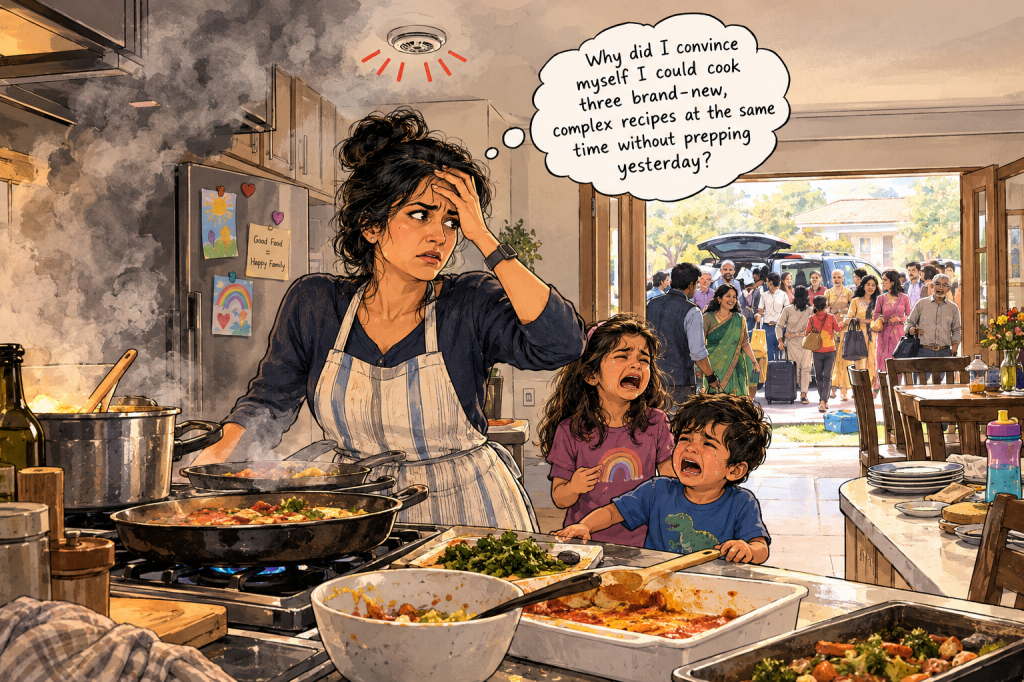
The Busy Homemaker: You stand in the kitchen surrounded by billowing smoke alarms, crying kids, and half-cooked side dishes while twenty extended family members pull into the driveway. You think to yourself, “Why did I convince myself I could cook three brand-new, complex recipes at the same time without prepping yesterday?”

The Small Business Owner: It is the launch day of your boutique’s biggest holiday weekend sale. The line of eager customers stretches around the corner, and suddenly your single tablet card reader loses Wi-Fi connection and powers off. The line stalls, customers get frustrated and walk away, and you think, “I should have tested the backup system yesterday.”
Conducting an autopsy after the fact feels productive, thorough, and responsible. But a post-mortem only tells you how the plan died.
In aerospace and high-performance operations, waiting for a mechanical failure or a near-miss before you evaluate your vulnerability is an expensive way to stay alive. If you want to build true resilience, you do not wait for the wreckage to hit the floor.
You run the post-mortem before you launch. You conduct a pre-mortem.
The Cognitive Trap of “I Knew It All Along”
When an effort collapses, our standard review process falls straight into hindsight bias (Fischhoff, 1975). Once an outcome is known, our brains automatically rewrite history to convince us that the failure was entirely predictable. We tell ourselves we saw the warning signs miles away.
If disaster was so obvious, why did we push forward anyway?
Human performance researchers point to three primary mental culprits:
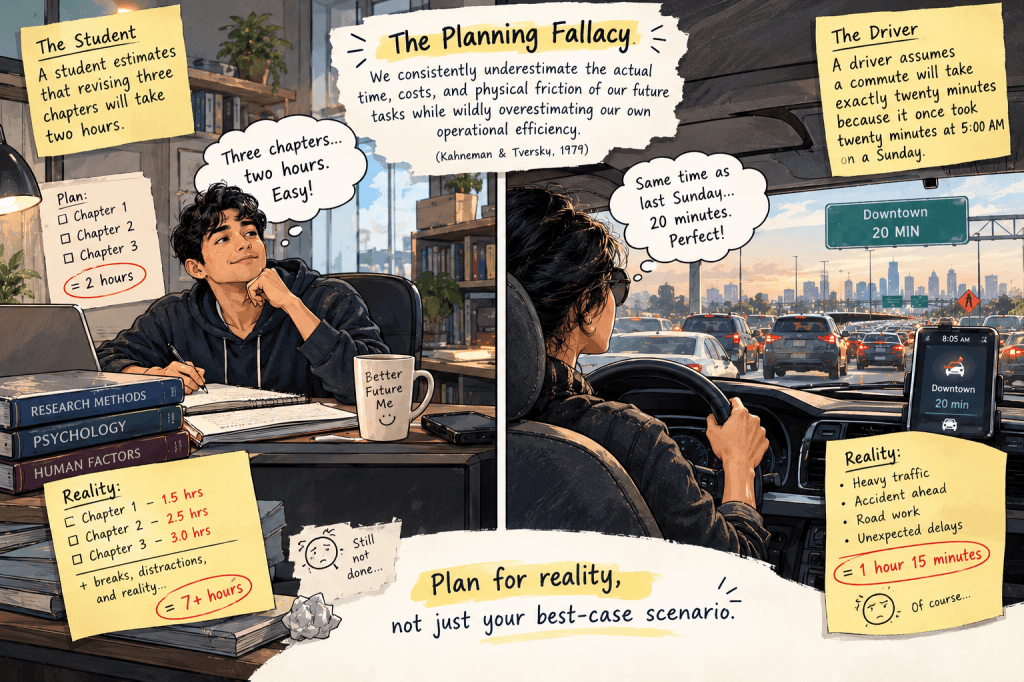
The Planning Fallacy: We consistently underestimate the actual time, costs, and physical friction of our future tasks while wildly overestimating our own operational efficiency (Kahneman & Tversky, 1979). A student estimates that revising three chapters will take two hours; a driver assumes a commute will take exactly twenty minutes because it once took twenty minutes at 5:00 AM on a Sunday.
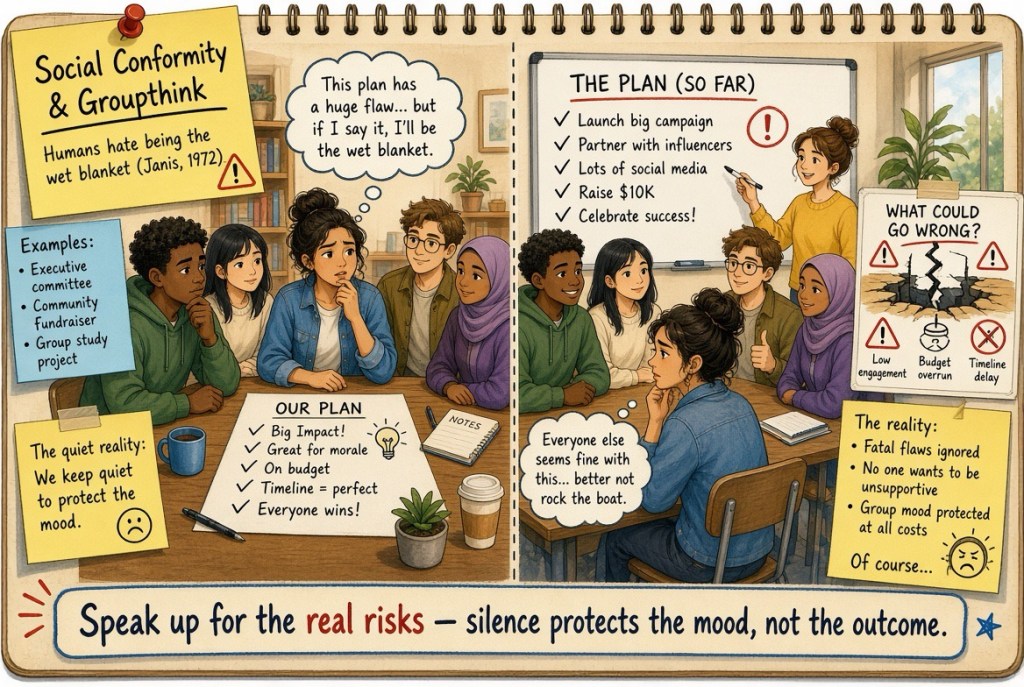
Social Conformity and Groupthink: Humans hate being the wet blanket (Janis, 1972). Whether you are sitting in an executive committee, planning a community fundraiser with friends, or coordinating a group study project, pointing out fatal flaws makes people feel unsupportive. We keep quiet to protect the mood.
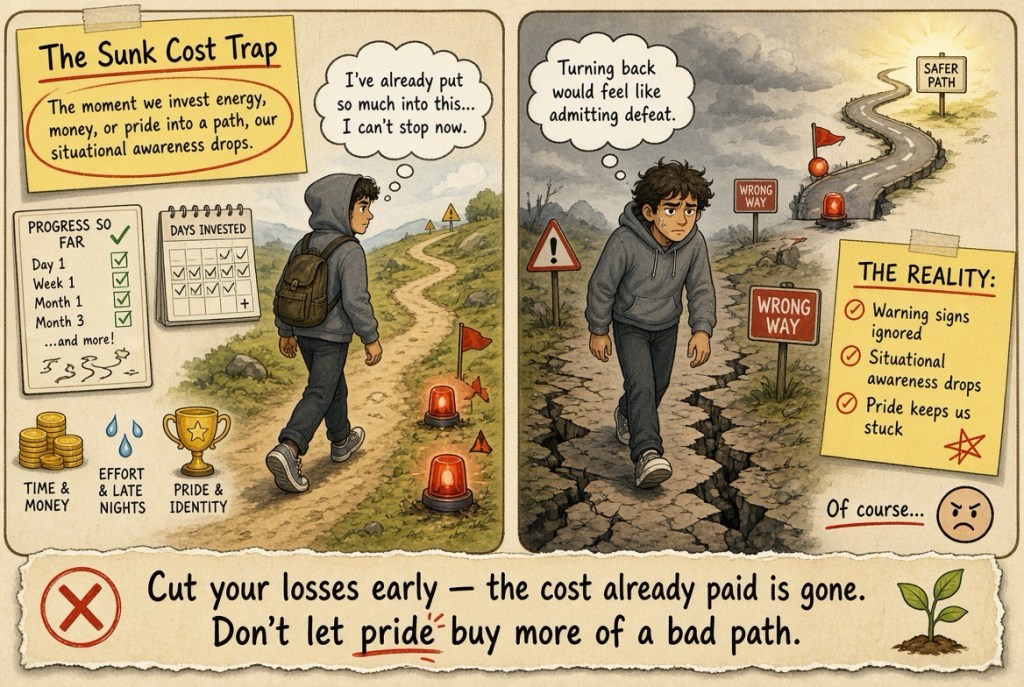
The Sunk Cost Trap: The moment we invest energy, money, or pride into a path, our situational awareness drops. We ignore flickering warning lights because turning back feels like an admission of defeat.
Hindsight turns an avoidable oversight into a useless lecture. A pre-mortem turns prospective failure into proactive tactical foresight.
Flipping the Script: Prospective Hindsight
Cognitive psychologist Gary Klein (2007) pioneered the pre-mortem by leveraging a unique cognitive mechanism: prospective hindsight.
When researchers asked groups to identify why a future event might happen versus telling them it already did happen, the group that imagined a settled, historic fact generated 30 percent more explanations for failure (Mitchell et al., 1989).
When you ask people, “What might go wrong with this schedule?” you trigger polite optimism and defensive reassurance. People shrug and say, “We’ll make it work.”
The pre-mortem aggressively flips the frame:
“Fast-forward to tomorrow evening. The plan failed completely. The paper is late, dinner is ruined, the sale collapsed, or you missed your flight. The disaster is a confirmed fact. Tell me how it happened.”
By assuming total collapse as a given reality, you eliminate the social pressure to play nice. Nobody needs to worry about insulting someone’s idea because the failure is already an accepted fact. Raising red flags transforms from cynicism into creative problem-solving.
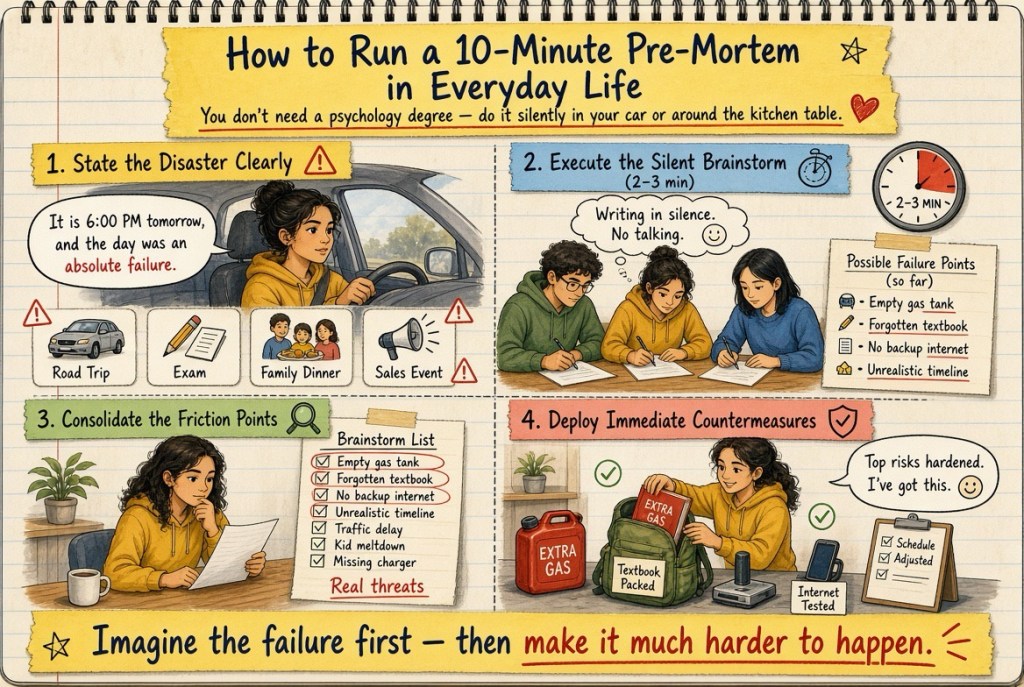
How to Run a 10-Minute Pre-Mortem in Everyday Life
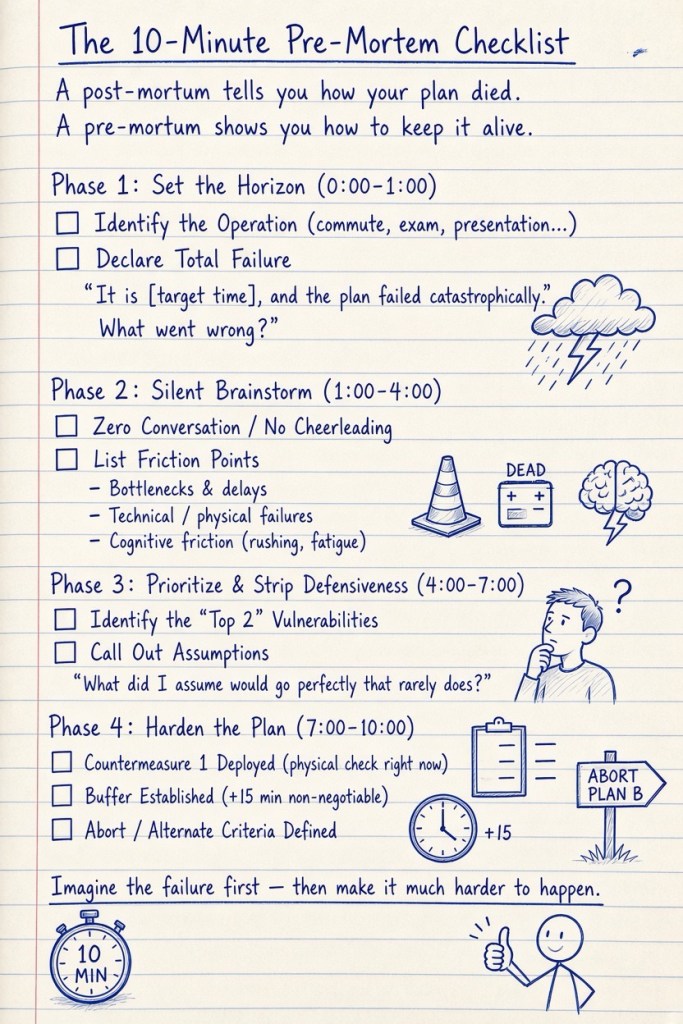
You do not need an industrial psychology degree or a lengthy retreat to use this tool. You can run it silently in your car or aloud around a kitchen table:
1. State the Disaster Clearly: Pick your upcoming challenge—a road trip, a commute to work, an exam, a family dinner, or a sales event. State the catastrophe with vivid certainty: “It is 6:00 PM tomorrow, and the day was an absolute failure.”
2. Execute the Silent Brainstorm (2 to 3 Minutes): Set a timer. Write down every single weak link, point of friction, or assumption that contributed to the collapse. If you are doing this with a team, family members, or classmates, everyone writes in complete silence so that authority figures don’t sway the room.
3. Consolidate the Friction Points: Look at the list objectively. You will immediately notice the real operational threats: The empty gas tank, the forgotten textbook, the lack of backup internet, or the unrealistic cooking timeline.
4. Deploy Immediate Countermeasures: Pick the two or three most catastrophic failure points and harden your plan immediately.
Fix the Leaks on Dry Ground
High performers do not succeed because they possess flawless luck or supernatural discipline. They succeed because they systematically locate and patch their vulnerabilities before the storm hits.
A post-mortem reviews the crash after the smoke clears. A pre-mortem prevents the collision while the vehicle is still parked safely in the garage. Run a pre-mortem before your next busy morning, your next road trip, or your next major endeavor, and patch the cracks while you are still standing on dry ground.
References
Fischhoff, B. (1975). Hindsight is not equal to foresight: The effect of outcome knowledge on judgment under uncertainty. Journal of Experimental Psychology: Human Perception and Performance, 1(3), 288–299. https://doi.org/10.1037/0096-1523.1.3.288
Janis, I. L. (1972). Victims of groupthink: A psychological study of foreign-policy decisions and fiascoes. Houghton Mifflin.
Kahneman, D., & Tversky, A. (1979). Intuitive prediction: Biases and fallacious self-correcting mechanisms. TIMS Studies in Management Science, 12, 313–327.
Klein, G. (2007). Performing a project premortem. Harvard Business Review, 85(9), 18–19.
Mitchell, D. J., Russo, J. E., & Pennington, N. (1989). Back to the future: Temporal perspective in the explanation of events. Journal of Behavioral Decision Making, 2(1), 25–38. https://doi.org/10.1002/bdm.3960020103


Leave a Reply