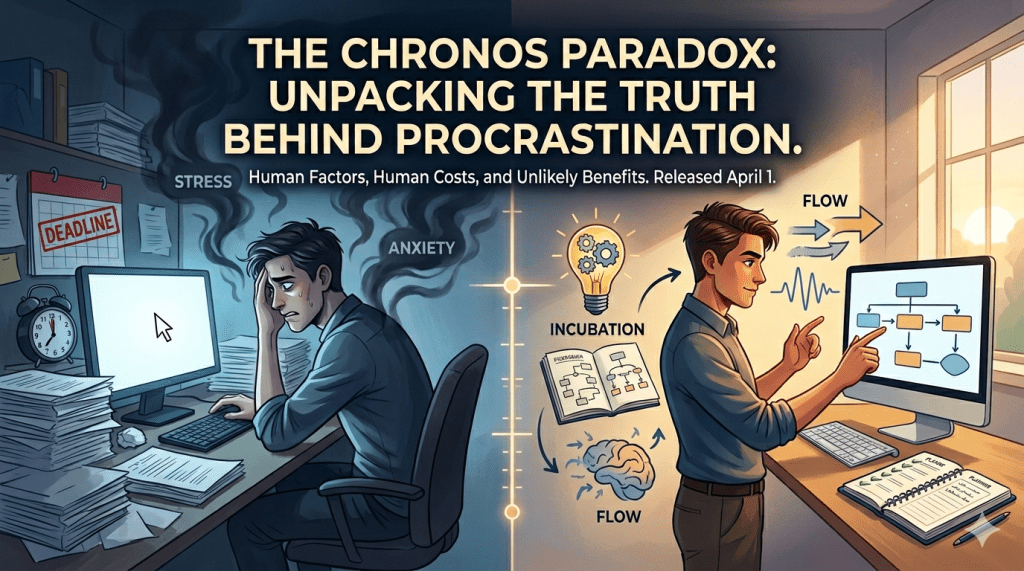
It was originally slated for April 1st. The irony of releasing a 2,000-word deep dive on procrastination several days late is not lost on me—in fact, it’s the perfect case study. While April Fools’ Day is traditionally the domain of the prankster, procrastination is the most enduring prank we play upon ourselves. We whisper the seductive lie—“I’ll feel more like it tomorrow”—only to find that “Tomorrow” is a mythical land where 99% of human productivity, ambition, and potential goes to rest.
From the specialized lens of human factors engineering and operational psychology, procrastination is not merely a failure of “willpower.” It is a systemic breakdown in the human “user interface.” It is a mismatch between our evolutionary neurological architecture and the hyper-complex, cognitively demanding environment of the 21st century.
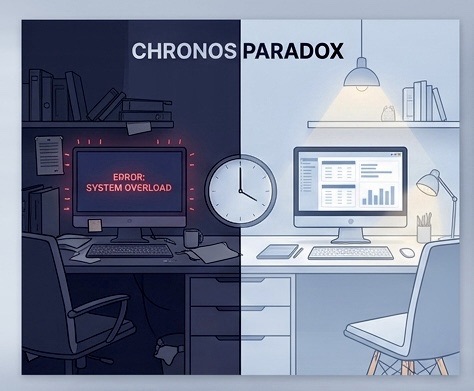
Section I: The Neuro-Ergonomics of the Human Brain
To understand why we delay, we must first understand the “hardware” upon which our consciousness runs. In human factors, we often discuss the human-machine interface (HMI). In the case of procrastination, the “machine” is our brain, and the “user” is our conscious intent.
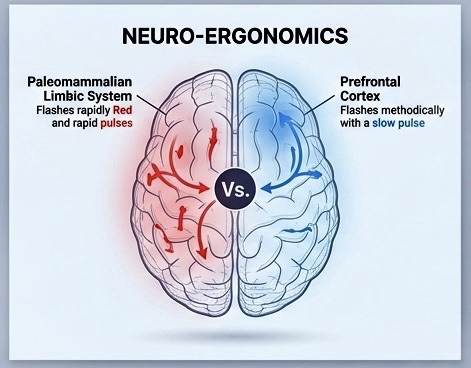
1. The Limbic System vs. The Prefrontal Cortex
The human brain is not a singular, unified processor; it is a collection of systems often at odds with one another.
• The Limbic System (The “Paleomammalian” Brain): This is one of the oldest and most dominant portions of our neurology. It is fast, instinctive, and geared entirely toward immediate survival and emotional regulation. It operates on the “Pleasure Principle”—it wants to avoid pain and seek comfort now.
• The Prefrontal Cortex (PFC): This is the “Executive Office.” Located right behind the forehead, the PFC is responsible for complex planning, understanding future consequences, and social behavior.
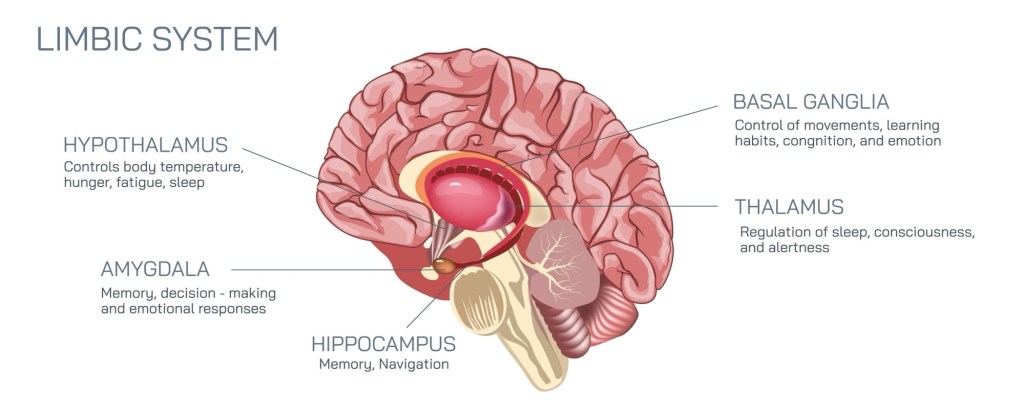
When you sit down to tackle a difficult, ambiguous task—like drafting a new syllabus or analyzing leadership safety—the PFC recognizes the long-term value. However, the Limbic System detects the anxiety or boredom associated with the task. Because the Limbic System is faster and more hard-wired, it triggers a “micro-flight” response. You don’t run out of the room, but you “flee” into a low-stakes task like checking email or scrolling through social media. This is what Sirois and Pychyl (2013) describe as the “priority of short-term mood regulation.”
2. The Zeigarnik Effect and Cognitive Load
In the 1920s, psychologist Bluma Zeigarnik discovered that our brains have a natural tendency to keep “unfinished” tasks in an active state of tension. From a human factors perspective, every procrastinated task is a “leaking” background process in your mental RAM. Even when you are watching Netflix to avoid a project, your brain is still dedicating a portion of its processing power to that unfinished task. This results in chronic Cognitive Load, leading to decision fatigue and reduced performance in other areas of life.
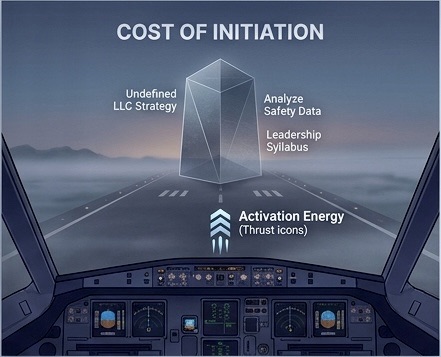
Section II: The “Cost of Initiation” and Task Design
In aviation physiology and aerospace psychology, we often study the “activation energy” required for a pilot to respond to a stimulus. Procrastination is essentially an initiation cost that has become too high for the operator to pay.
1. The Planning Fallacy
Humans are notoriously poor estimators of time—a phenomenon known as the Planning Fallacy. We consistently underestimate how long a future task will take, while simultaneously overestimating our future levels of energy and motivation. This is a failure of metacognition. We treat “Future Me” as a stranger who magically possesses the discipline “Present Me” currently lacks.
2. Task Ambiguity as a Stressor
If a task is poorly defined, the brain perceives it as a threat. In human factors engineering, we know that clear feedback and well-defined controls reduce error. When a goal is too vague, the brain cannot form a concrete plan of action, and the resulting “uncertainty” triggers the Limbic System’s avoidance mechanism.
“Procrastination is the fear of success. People procrastinate because they are afraid of the success that they know will result if they move ahead now.” — Denis Waitley
Section III: The Disadvantages – Assessing the Damage
The physiological and professional costs of chronic delay are documented and severe.
1. The Physiological Toll
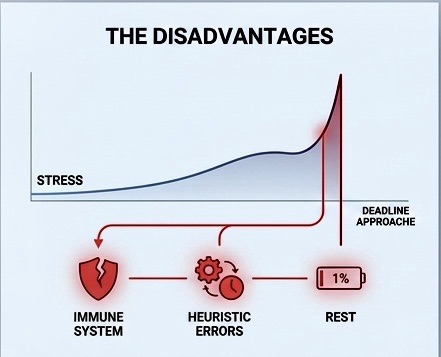
Chronic procrastinators suffer physically. Tice and Baumeister (1997) found that while procrastinators reported lower stress early in a project cycle, they suffered significantly more toward the end. The cumulative stress of the “crunch period” leads to weakened immune systems, increased cardiovascular strain, and poor sleep hygiene.
2. Performance Degradation and Error
In high-stakes environments—such as aerospace or medicine—procrastination is a safety hazard. Rushed work leads to “heuristic shortcuts,” where we miss critical details because we are focused solely on the “finish line” rather than the process.
Section IV: The Surprising Advantages – “Active” vs. “Passive”
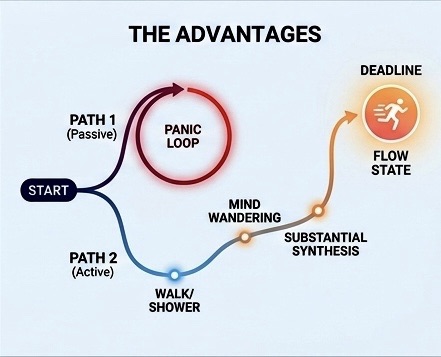
Is all delay bad? Modern research suggests a nuance. Chu and Choi (2005) introduced the concept of Active Procrastination. Unlike passive procrastinators who are paralyzed by fear, active procrastinators make a deliberate decision to delay.
1. The “Flow” of the Deadline
Some individuals perform better under the adrenaline surge of a looming deadline. This “arousal-seeking” behavior can lead to a state of Flow—a deep immersion where the deadline serves as a focusing lens that filters out distractions.
2. The Incubation Effect
In creative problem-solving, “stepping away” is a recognized phase. While it may look like procrastination, the subconscious brain is performing Incubation. By not forcing the solution immediately, we allow the brain to form non-linear connections. This is why many “Aha!” moments occur during activities that look like dawdling—showering, walking, or even doing the dishes.
Section V: Strategic Interventions (The Human Factors Toolbox)
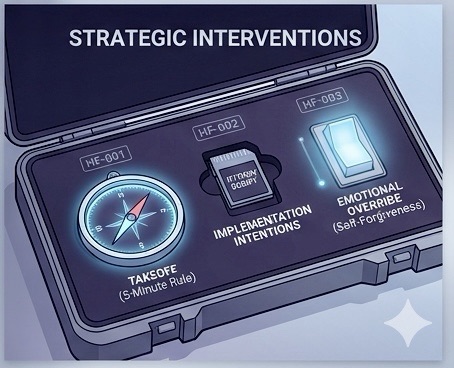
If we treat procrastination as a design problem, we can apply “engineering” solutions to fix it.
• Lowering Activation Energy (The 5-Minute Rule): The hardest part of any flight is takeoff. Commit to working for only five minutes. Once the operator is in “motion,” the psychological cost of continuing is lower than the cost of starting.
• Implementation Intentions: Research shows that vague goals fail. Use “If-Then” planning: “If it is 9:00 AM and I have my coffee, then I will open the syllabus draft.” This removes the “decision” from the moment.
• Self-Forgiveness: Wohl, Pychyl, and Bennett (2010) found that students who forgave themselves for procrastinating on a first exam were significantly more likely to study early for the second. Forgiveness clears the emotional slate.
Conclusion: Mastering the Clock
The fact that this post was released on April 5th instead of April 1st isn’t just a delay—it’s a demonstration. It proves that even when we understand the human factors of our own brains, we are still subject to them.
Procrastination is not a sign of a broken character; it is a sign of a complex brain doing exactly what it was evolved to do—protect you from perceived stress. By applying the principles of human factors—clear task design, emotional regulation, and physiological awareness—we can stop fighting our nature and start engineering our success.
The best time to start was four days ago. The second best time is right now.
References
• Chu, A. H., & Choi, J. N. (2005). Rethinking procrastination: Positive effects of “active” procrastination behavior on attitudes and performance. The Journal of Social Psychology, 145(3), 245–264. https://doi.org/10.3200/SOCP.145.3.245-264
• Ferrari, J. R. (2010). Still procrastinating: The no-regrets guide to getting it done. John Wiley & Sons.
• Sirois, F., & Pychyl, R. (2013). Procrastination and the priority of short-term mood regulation: Consequences for future self. Social and Personality Psychology Compass, 7(2), 115–127. https://doi.org/10.1111/spc3.12011
• Tice, D. M., & Baumeister, R. F. (1997). Longitudinal study of procrastination, performance, stress, and health: The costs and benefits of dawdling. Psychological Science, 8(6), 454–458. https://doi.org/10.1111/j.1467-9280.1997.tb00460.x
• Wohl, M. J., Pychyl, R. J., & Bennett, S. H. (2010). I forgive myself, now I’ll study: How self-forgiveness for procrastinating can reduce future procrastination. Personality and Individual Differences, 48(7), 803–808. https://doi.org/10.1016/j.paid.2010.01.028

 Human Factors HQ
Leave a comment