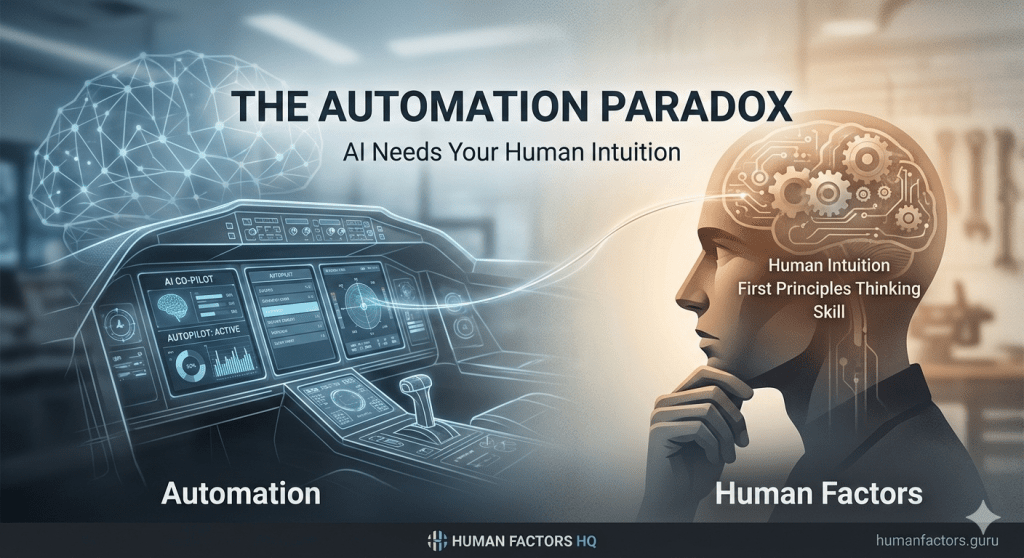
We’ve all been there. You’re following your GPS blindly until it tells you to turn left into a lake, or you’re relying so heavily on Autocorrect that you forget how to spell “bureaucracy.” In 2026, as AI becomes our ubiquitous “digital co-pilot,” we are hitting a psychological wall that pilots have been hitting for decades: The Automation Paradox.
The paradox is simple but dangerous: The more reliable an automated system becomes, the less the human operator focuses. Then, when the system eventually fails (and they all do), the human is too “out of the loop” to take over effectively.
The “Clumsy” Human in a High-Tech World
In aerospace physiology, we study how automation changes the brain. When a pilot engages autopilot, their cognitive load drops. This is great for fatigue management, but it leads to Skill Decay. Research in the Journal of Applied Research in Memory and Cognition suggests that as we rely on automated “assistants,” our internal mental models of how tasks work begin to wither (Casner & Schooler, 2015).
Think of it like a muscle. If a machine lifts the weights for you every day, you’ll look like a bodybuilder until the machine breaks. Then, you’ll realize you don’t actually have the strength to lift a single plate.
The “Automation Surprise”
In aviation, an “Automation Surprise” happens when the flight computer does something the pilot didn’t expect, and the pilot asks the dreaded question: “What’s it doing now?” In your daily work—whether you are using AI to write code, diagnose a patient, or manage a supply chain—you face the same risk. If you don’t understand the First Principles of the task, you won’t recognize when the AI has hallucinated a “turn into the lake.” According to Parasuraman and Manzey (2010), “Automation Bias” causes humans to favor suggestions from automated systems even when they contradict their own senses or logic.
How to Stay “Flight Ready” in the Age of AI
To avoid becoming a passenger in your own career, you need to maintain what we call Situational Awareness (SA). Here is how to keep your “Human Factors” sharp:
1. Practice “Manual Reversion”: Every once in a while, do the task without the AI. Write the draft first, then ask the AI to polish it. Solve the math, then check it with the tool.
2. Verify, Don’t Just Trust: Treat AI like a junior trainee, not an oracle. Cross-reference its outputs with credible sources.
3. Monitor the “Why,” Not Just the “What”: Don’t just look at the final answer the AI gives you. Ask yourself if the logic used to get there aligns with your professional expertise.
The Bottom Line
The goal of human factors isn’t to fight technology; it’s to integrate with it safely. AI is a powerful engine, but you are still the pilot in command. If you let your manual skills decay, you aren’t just losing a craft—you’re losing the ability to save the mission when the “autopilot” disconnects.
References
Casner, S. M., & Schooler, J. W. (2015). Thoughts in flight: Automation use and pilots’ task-related and task-unrelated thought. Journal of Applied Research in Memory and Cognition, 4(4), 434-443. https://doi.org/10.1016/j.jarmac.2015.08.005
Parasuraman, R., & Manzey, D. H. (2010). Complacency and bias in human use of automation: An attentional self-regulation account. Human Factors: The Journal of the Human Factors and Ergonomics Society, 52(3), 381-410. https://doi.org/10.1177/0018720810376055
Strauch, B. (2017). Ironies of automation: Still unresolved after all these years. IEEE Transactions on Human-Machine Systems, 48(5), 419-433.

 Human Factors HQ
Leave a comment