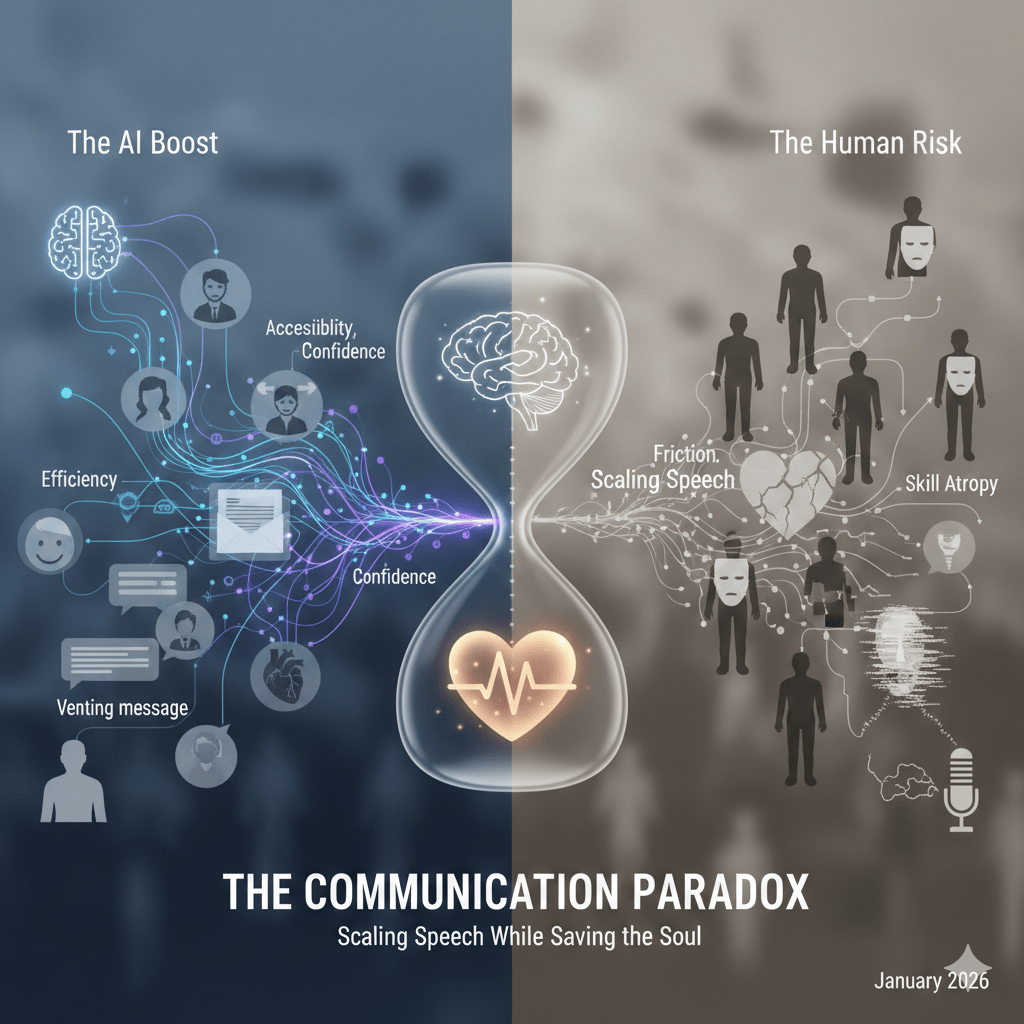
The integration of Artificial Intelligence (AI) into our daily interactions has fundamentally changed how we exchange information. As of 2026, we have moved past simple chatbots into the era of Agentic AI—autonomous systems that don’t just draft messages but manage entire project workflows and complex negotiations.
However, as we embrace these tools, we find ourselves at a crossroads. While AI offers unprecedented efficiency, it introduces a “human factor” that is reshaping our psychology and our relationships.
The Advantages: Efficiency, Accessibility, and Confidence
1. Breaking the “Blank Page” Anxiety
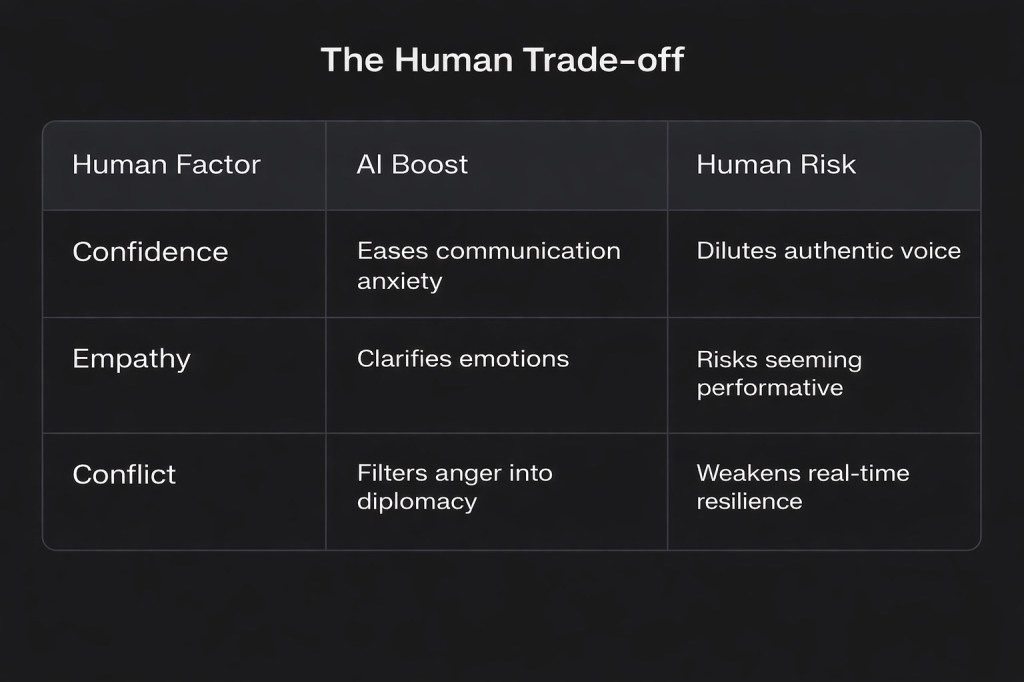
For many, the hardest part of communication is starting. AI acts as a psychological buffer, reducing the cognitive load and “blank page” anxiety that often leads to procrastination. By providing a solid starting point, AI empowers people—especially neurodivergent individuals—to navigate social norms and professional tone with newfound confidence.
2. Radical Accessibility
AI-driven multimodal translation has reached near-human levels of nuance. Real-time translation now accounts for cultural idioms, allowing for a globalized empathy where language is no longer a barrier to collaboration. Furthermore, AI tools now allow those with visual or speech impairments to communicate with high emotional intelligence, ensuring no voice is left unheard.
3. Emotional Regulation
In heated moments, AI serves as an “emotional filter.” A user can vent their frustration into a prompt, and the AI can help rephrase it into a constructive, professional message. This prevents bridge-burning and allows for rational outcomes in emotional situations.
The Disadvantages: Friction, Trust, and Skill Atrophy
1. The “Erosion of Authenticity”
As AI-assisted writing becomes the default, a trust deficit has emerged. Human connection is built on the knowledge that someone took the time to think of us. When a recipient senses a message is purely synthetic, it can create a feeling of “digital hollowness.” If the effort is outsourced, the perceived value of the relationship often diminishes.
2. The Atrophy of Soft Skills
Communication is a muscle. By relying on AI to navigate difficult conversations or craft apologies, we risk a decline in “human grit.” There is a growing concern that we are losing the ability to handle conflict in real life, face-to-face, without a digital mediator to soften the blow.
3. Misinformation and the “Uncanny Valley”
The rise of deepfakes and synthetic identities has made it harder to discern truth. This creates a state of constant skepticism, where even genuine human outreach might be viewed with suspicion. This “uncanny valley” of connection makes it difficult to build the rapport necessary for deep, meaningful collaboration.
The Human Trade-off
Conclusion: Keeping the “Human in the Loop”
AI in communication is a powerful tool for scaling reach, but it remains a poor substitute for genuine presence. As we move deeper into 2026, the goal is not to let AI speak for us, but to let it handle the mechanics so we can focus on the meaning.
The most valuable skill in the AI age isn’t knowing how to prompt—it’s knowing when to put the AI away and speak from the heart.

 Human Factors HQ
Leave a comment