Introduction
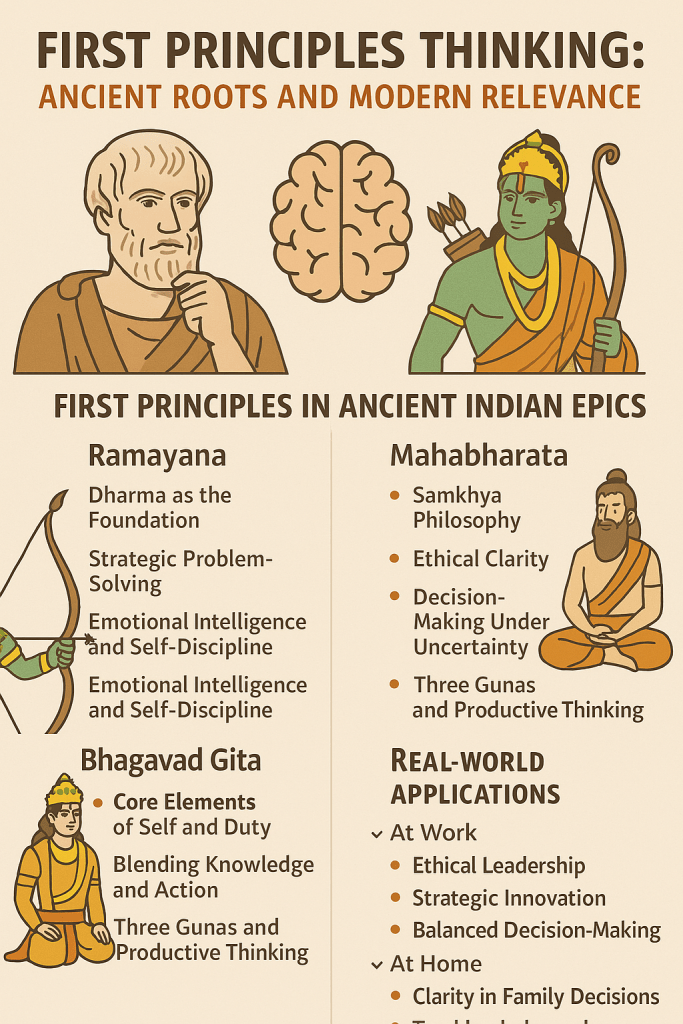
First principles thinking—breaking down complex problems to their most basic truths and reasoning up from there—is often attributed to Aristotle. However, this approach is deeply embedded in ancient Indian wisdom, as reflected in the Ramayana, Mahabharata, and Bhagavad Gita. These epics offer profound examples of fundamental reasoning, ethical clarity, and strategic problem-solving that align closely with first principles thinking.
First Principles in Ancient Indian Epics
Ramayana
• Dharma as the Foundation: Lord Rama’s unwavering commitment to dharma (righteous duty) is a prime example of first principles thinking. Faced with exile, Rama does not simply follow tradition or societal pressure; he returns to the core principle of honoring his father’s word, even at great personal cost. This adherence to fundamental values over convenience or precedent is the essence of first principles thinking.
• Strategic Problem-Solving: The building of the Ram Setu (bridge to Lanka) showcases how Rama and his allies approached a seemingly insurmountable challenge by focusing on the basic objective—crossing the ocean. Instead of being constrained by conventional methods, they devised a creative, collaborative solution rooted in the core need.
• Emotional Intelligence and Self-Discipline: Rama’s leadership is marked by self-mastery and empathy, not just brute strength. He balances emotion and reason, demonstrating that true leadership and decision-making begin with understanding and mastering one’s own mind—another first principle.
Mahabharata
• Sankhya Philosophy: The Mahabharata, particularly in the Shanti Parva, discusses the concept of Prakriti (the first principle of the universe) and Purusha (consciousness). Sankhya philosophy, which underpins much of the Mahabharata’s metaphysics, is fundamentally about identifying the root causes and principles of existence, distinguishing between the material (Prakriti) and the conscious (Purusha).
• Ethical Clarity: Characters like Yudhishthira are repeatedly tested on their commitment to truth and justice. When faced with moral dilemmas, they return to the foundational principles of righteousness, rather than merely following precedent or expediency.
• Decision-Making Under Uncertainty: The epic’s many strategic discussions—such as Krishna’s counsel to Arjuna—emphasize stripping away confusion and focusing on the essential duties and truths of the moment, a hallmark of first principles reasoning.
Bhagavad Gita
• Core Elements of Self and Duty: The Bhagavad Gita urges Arjuna to look past social conventions and emotional turmoil, and instead focus on his fundamental duty (svadharma). Krishna teaches that action must be rooted in knowledge and principle, not mere tradition or fear.
• Blending Knowledge and Action: The Gita explains that right action is the outward expression of inner knowledge. Krishna emphasizes that knowledge without action is ineffective, and action without knowledge is misguided—underscoring the need to base all efforts on foundational truths.
• Three Gunas and Productive Thinking: The Gita classifies thoughts and actions according to the three gunas (sattva, rajas, tamas), encouraging individuals to discern the root qualities driving their behavior and to consciously cultivate clarity and purpose.
Real-World Applications
At Work
• Ethical Leadership: Like Rama, modern leaders can ground their decisions in core values, building trust and integrity within teams.
• Strategic Innovation: Drawing inspiration from ancient epics, teams can approach challenges by identifying the true objective and devising creative solutions from the ground up, rather than relying on analogies or outdated practices.
• Balanced Decision-Making: The blend of knowledge and action advocated in the Bhagavad Gita is directly applicable to workplace problem-solving, ensuring that strategies are both principled and effective.
At Home
• Clarity in Family Decisions: Applying first principles thinking to household matters—such as budgeting or planning—helps focus on true needs and desired outcomes, reducing complexity and stress.
• Teaching Independence: Encouraging children to question assumptions and seek foundational truths fosters critical thinking and resilience, as exemplified by the teachings of the Gita.
Conclusion
First principles thinking is not just a modern mental model; it is a timeless approach deeply rooted in Indian epics. The Ramayana, Mahabharata, and Bhagavad Gita offer enduring lessons on returning to core truths, questioning assumptions, and building solutions from the ground up. By integrating these ancient insights, individuals and organizations can unlock greater creativity, ethical clarity, and resilience in both professional and personal spheres.
References
https://www.wisdomlib.org/hinduism/essay/samkhya-thoughts-in-the-mahabharata/d/doc1210269.html
https://www.radhakrishnatemple.net/blog/power-of-positive-thoughts-bhagavad-gita-teachings/
https://www.britannica.com/topic/Ramayana-Indian-epic
https://www.swami-krishnananda.org/disc/disc_18.html

 Human Factors HQ
Leave a comment