Why it matters?
What is Sleep?
According to Merriam Webster, a modern definition of sleep is as follows, “the natural, easily reversible periodic state of many living things that is marked by the absence of wakefulness and by the loss of consciousness of ones’ surroundings, is accompanied by a typical body posture (such as lying down with the eyes closed), the occurrence of dreaming, and changes in brain activity and physiological functioning. It is made up of several cycles of non-REM and REM sleep and is usually considered essential to the restoration and recovery of vital bodily and mental functions.”
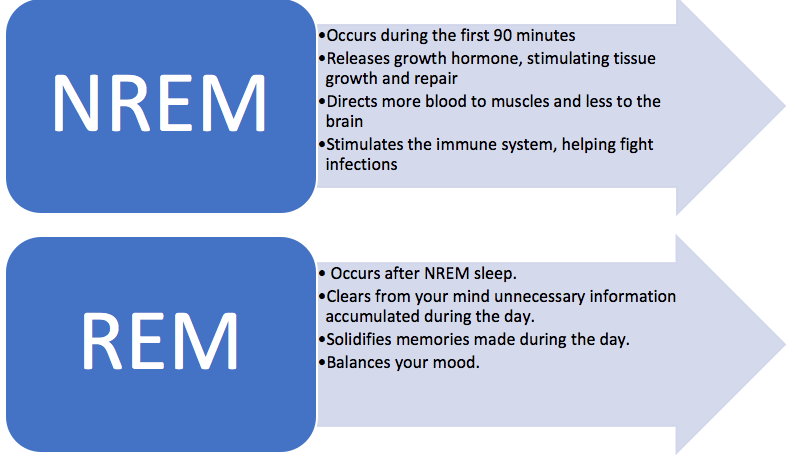
However, just 70 years ago, most people thought of sleep as a passive, dormant part of our daily activity. Now we know, that sleep is a dynamic activity that is necessary to keep the body and brain in top-notch shape. When we sleep, we experience two distinct phases of sleep – Non-Rapid Eye Movement (NREM) and Rapid Eye Movement (REM). Each phase is associated with specific functions that renew and repair the body and brain. In normal sleep, both phases will cycle through four stages of sleep to include REM phase (4th stage).
NREM Vs. REM SLEEP
SLEEP STAGES
As mentioned above, we usually pass though Stages 1 – 3 and REM sleep in a progressive cycle. However, the progression is not sequential (Sleep begins in stage 1 and progresses to stage 2 and stage 3. After stage 3 sleep, stage 2 is repeated before entering REM). Once REM sleep is complete, it starts over again with stage 2. Sleep cycles through these these stages roughly four to five times throughout the night.
According to National Sleep Foundation, adults and children spend almost 50% of their total sleep time in stage 2 sleep, about 20% in REM sleep, and the remaining 30% in other stages. Infants, by contrast, spend about half of their sleep time in REM sleep.
So, what happens during these sleep stages?
| Stage 1 Note – if you are suffering from sleep deprevation, you can slip into this stage a few seconds to a minute at a time throughout the day. Note – people awaken in this stage often remember fragmented visual images. | Light sleep phase, lasts about 5 – 10 minutes. The brain produces high amplitude theta waves, which are very slow brain waves. Feeling of calm, sudden arm and leg movements (also a disorder in some folks known as Periodic Limb Movement of sleep aka PLMS). Heart rate lowers, shallow and regular breathing, eyes slowly roll around or can open with no awareness of surroundings. Awareness of sounds or conversations is still registered. This stage is usually considered a transition phase between wakefulness and sleep. |
| Stage 2 | Beginning of sleep, lasts about 20 minutes. Body temperature decreases, breathing and heart rate slows down (in fact, it becomes more regular), and awareness slowly fades away. Rapid bursts of rhythmic brain waves known as sleep spindles are produced by the brain. |
| Stage 3 Note – Sleepwalking tends to occur most often during deep sleep of this stage. Note – Studies also link this phase to bedwetting. However, new research highlights that bedwetting can occur in other stages of sleep as well. | As the body drifts on stage 3 sleep, muscles will relax, blood pressure and breathing rate will further drop and body will experience deep sleep. Brain produces deep, slow brain waves known as delta waves. Body is less responsive to noises and activity in the environment. It is considered a transition phase between a very deep sleep and light sleep. |
| REM Note – If you have ever experienced a nightmare and felt you were not able to move, you have experienced paradoxical sleep. | As the body transitions from deep sleep to REM, the brain becomes active and respiration rate increases, Dreams will occur and eyes will move rapidly. It is also known as paradoxical sleep because while the brain becomes more active, muscles are relaxed and immobilized. REM begins approximately 90 minutes after falling asleep. The first REM phase lasts a short amount of time, but each cycle becomes longer as the night (sleep) progresses. It can last up to an hour as sleep progresses. |
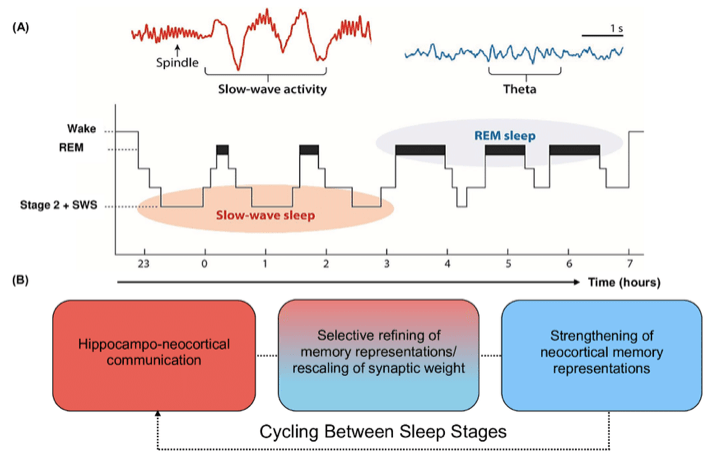
In seven to eight hours of sleep, an individual will cycle through these stages about three to four times in one night. As mentioned earlier, progression of night will contain more and longer bouts of REM sleep compared to Stage 3 sleep. As dawn breaks (morning), REM sleep might last 30 minutes with no stage 3 sleep. This is known as the “Sleep Architecture”
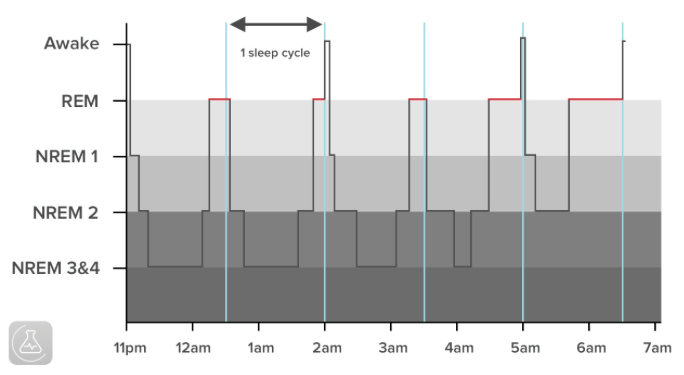
When normal sleep cycles are disrupted, an individual will experience tiredness and grogginess upon waking up. This phenomenon is also known as sleep inertia. So, if you have used an alarm clock to wake up earlier than normal, you have experienced sleep inertia. It can last for 15-30 minutes, but is also reported in research studies to last as long as 4 hours. We usually rely on caffeine to get rid of this state.

Sleep inertia is the result of sudden awakening during REM phase. During REM phase, individuals still have high levels of melatonin (hormone), and it will take roughly 30 minutes to 4 hours to wash out, making you vulnerable to mistakes even during well known routine actions (driving to work).
Let’s look at ways, how our habits, routines and choices impacts our sleep architecture. Some people fall asleep but can’t seem to stay asleep, tossing and turning all night, while others stay awake staring at the ceiling. Let’s take a look at things that alter or rob us of our sleep. NOTE – sleep architecture alters with age.

Caffeine – one of the three most common drugs available to us. It is a natural substance extracted from plants. Natural sources of caffeine are coffee beans, tea leaves and cocoa beans. It is a stimulant that acts as an “adenosine receptor antagonist.” Adenosine is a substance produced by the body that promotes sleepiness. Caffeine blocks the adenosine receptor to keep your from falling sleepy. Caffeine also can be produced synthetically. It increases alertness, often making it difficult to fall asleep. It also makes your sleep lighter and shorter, and usually increases your number of trips to the bathroom throughout the night.
It actually starts to affect our body very quickly and reaches a peak level in the blood within 30 to 60 minutes. It also has a half-life of roughly 6 hours (it takes roughly 6 hours for your body to eliminate half of the quantity ingested). The remaining caffeine stays in the body for another 6 hours or so.
As mentioned above, caffeine is disruptive on our sleep. The effects of caffeine on sleep depend not only on the amount of caffeine ingested at bedtime, but also on the amount of caffeine ingested over the whole day. According to research, caffeine can delay the circadian rhythm (body clock) reducing total sleep time. It also reduces the amount of deep sleep.
The effects of caffeine are more profound when consumed in the afternoon or evening. According to research, caffeine consumed 6 hours before bedtime reduced total sleep time by 1 hour. These effects can be stronger in older adults as well as it depends on the amount of caffeine ingested. It takes our bodies a longer time to process it.
Caffeine is also dangerous at high doses (energy drinks and/or synthetic powder form). And, an individual can also experience withdrawal symptoms.
We certainly cannot live without it in 24/7 environment. So, here are a few recommendations that can help with sleep improvement.
- Use caffeine products in moderation.
- Limit caffeine consumption to no more than about 300 to 400 mg per day (3 to 4 eight-ounce cups of coffee).
- Avoid post-lunch caffeine consumption from products such as cola, tea, coffee, energy drinks and even chocolate.
- If at all possible, train your mind for caffeine abstinence. A 2008 systematic review of research studies suggested that caffeine abstinence can not only enhance performance but also improve sleep quality. The authors concluded that caffeine abstinence significantly lengthened sleep duration and improved sleep quality. Furthermore, subjects had less difficulty falling asleep on days when they drank decaffeinated coffee.

Tobacco Products (Nicotine). Second most commonly used drug. Nicotine is a stimulant and using it within four hours of bedtime will disrupt sleep quality and cause an individual to wake at night. According to research, regular nicotine consumption (daily smoking or utilizing any other products) causes daytime sleepiness because of poor sleep quality during the night and early awakenings due to smoke urges. Tobacco users are also more likely to develop sleep apnea. Brain will also go through withdrawal symptoms while a smoker is sleeping, leading to restlessness.
It is highly recommended to quit using nicotine. However, if it all possible, stopping nicotine use at least 4 hours prior to bed time. For heavy smokers, start with not smoking one to two hours before bedtime. Quitting nicotine consumption in general will lead to many other health benefits.

Alcohol. Third most commonly used drug. A little nightcap will not help you sleep better. In fact, according to studies, alcohol consumption negatively affects sleep quality as it tricks the brain into thinking that the body is resting. Alcohol might help with inducing deep sleep in the beginning but as the body begins to process it, the effects are more disrupting to the sleep quality as well as quantity. It completely hijacks the REM sleep cycles and circadian rhythms.
According to research, alcohol is an highly effective suppression agent against melatonin (sleep facilitator hormone). And, just moderate alcohol consumption up to an hour before bed time can reduce melatonin production by nearly 20 percent. Therefore, leading to alterations in sleep architecture and causing sleep disruptions. Such as-
- frequently getting up to go to the bathroom
- Parasomnias (sleep walking and sleep eating)
- Snoring
Leading to greater risk of sleep disorders such as insomnia and obstructive sleep apnea. So, the more we drink before bed, the more pronounced these effects. As mentioned above, REM sleep disruptions may cause daytime drowsiness, poor concentration, fatigue, irritability and lead to long-term health issues, if such habits are unchecked.
Alcohol is such a sociocultural drug that it is hard to completely ignore or remove it from our lives. So, here are a few recommendations to improve sleep and overall health:
- Avoid large quantities of alcohol (limit to 2 – 3 drinks per week with enough time to metabolize the alcohol).
- Stay hydrated with water (not alcohol).
- Maintain nutrition (after alcohol consumption, a warm cup of herbal tea with honey might help).
- And, most importantly, it is highly recommended (research proven) to stop alcohol consumption at least four hours before bedtime to avoid sleep disruptions (dependent on the amount of alcohol consumed).
- If an individual is unable to sleep without alcohol, they are alcohol are dependent and will require professional help.
OTHER IMPORTANT SCIENCE BASED RECOMMENDATIONS TO IMPROVE SLEEP
- Sun or Bright light exposure during the day – helps regulate the biological clock, improves daytime energy as well as sleep quantity and quality. According to research, 2 hours of exposure improved sleep quantity by 2 hours and sleep efficiency (quality) by 80%.
- Reduce blue light exposure in the evening – i.e. avoid cell phones, computers and televisions that emit large amount of blue light two hours before bedtime. Most individuals will find it difficult to make this a regular habit. So, if possible, wear glasses that can block the blue light, or use smartphone display settings to automatically reduce blue light exposure. And, there’s also an app for that.
- Reduce irregular and long naps during the day – Research indicates that a 30 minutes nap can enhance daytime function, long irregular napping can negatively affect sleep, health and nighttime sleep.
- Be consistent with your sleep – As discussed above, circadian rhythms is a natural loop that aligns itself with sunrise and sunset. So, try to sleep and wake at consistent times even during the weekends and holidays. irregular sleep patterns and going to bed late on the weekends leads to poor sleep.
- As mentioned above, don’t drink alcohol, ingest nicotine or caffeine too close to bedtime.
- Bedroom environment optimization – in other words, eliminate distractions such as external noises and lights. Keep it quiet and dark. Even light emitted from an alarm clock can be a distraction, so, make sure to be deliberate in setting up your bedroom quiet, relaxing, clean and enjoyable place. This also includes a comfortable bed, mattress and a pillow (lifetime investment).
- Ensure that the bedroom temperature is comfortable – Research has found that bedroom temperature can negatively affect sleep quality (more than external noise). According to National Sleep Foundation, the ideal temperature is 65 degrees Fahrenheit (18.3 degree celsius). However, individual choice may vary based on their region, so, it is best to keep the thermostat set between 60 – 67 degrees Fahrenheit (15.6 – 19.4 degree celsius). NOTE – infants are more sensitive to ambient changes, therefore, it is recommended to keep the temperature at 69 degrees Fahrenheit (20.5 degrees celsius).
- Early Dinner – don’t eat late in the evening, it may negatively affect the sleep quality and quantity and leads to an hormonal imbalance. However, certain meals and snacks a few hours (roughly four hours) before bedtime might even help with sleeping better. A healthy proportional meal roughly 4 hours before sleep time can help people fall asleep faster. If a snack is required, opt for a healthier choice such as a warm glass of milk.
- Meditation – Try to build this into your pre-sleep routine. Meditation and other breathing exercises can help with relaxation and improve stress leading to good sleep. Other relaxation techniques such as a massage, listening to relaxing music, book reading, hot bath, deep breathing and visualization are all proven to work. Try out these methods and find what works best.
- Exercise – be regular. It is recommended to exercise roughly 30 – 60 minutes daily ( walking to lifting). It enhances your mood, relieves stress and have been proved to reduce symptoms of insomnia. It reduced time to fall asleep by 55%, total night wakefulness by 30% and anxiety by 15% and increased total sleep time by 18%, in one study. NOTE – Exercising too close to bedtime may cause sleep problems due to increased alertness and certain hormones such as epinephrine and adrenaline produced by the body during workout. So, find a good time (usually early mornings) or workout atleast four-six hours before bedtime. NOTE – a relaxing walk/stroll close to bedtime will not negatively affect sleep.
In conclusion, sleep is important to our health. Optimal individual health and well-being begins with a good night sleep. Research has linked insufficient sleep increased risk of obesity that can lead to type II diabetes and cardiovascular diseases. So, make an investment now into your sleep quality/quantity. Practice, incorporate and experiment with above tips and make SLEEP A TOP PRIORITY in your life.
References
Okamoto-Mizuno, K., & Mizuno, K. (2012). Effects of thermal environment on sleep and circadian rhythm. Journal of physiological anthropology, 31(1), 14. https://doi.org/10.1186/1880-6805-31-14
Kuo, T. B., Hong, C. H., Hsieh, I. T., Lee, G. S., & Yang, C. C. (2014). Effects of cold exposure on autonomic changes during the last rapid eye movement sleep transition and morning blood pressure surge in humans. Sleep medicine, 15(8), 986–997. https://doi.org/10.1016/j.sleep.2014.03.022
Haghayegh, S., Khoshnevis, S., Smolensky, M. H., Diller, K. R., & Castriotta, R. J. (2019). Before-bedtime passive body heating by warm shower or bath to improve sleep: A systematic review and meta-analysis. Sleep medicine reviews, 46, 124–135. https://doi.org/10.1016/j.smrv.2019.04.008
A.D.A.M. Medical Encyclopedia. (2014, June 12). Alcohol. Retrieved August 25, 2020, fromhttps://medlineplus.gov/alcohol.html
Park, S., Oh, M., Lee, B., Kim, H., Lee, W., Lee, J., Lim, J., & Kim, J. (2015). The Effects of Alcohol on Quality of Sleep. Korean Journal of Family Medicine, 36(6), 294–299. Retrieved from https://www.ncbi.nlm.nih.gov/pmc/articles/PMC4666864/
Centers for Disease Control. (2020, January 15). Alcohol and Public Health: Frequently Asked Questions. Centers for Disease Control and Prevention. Retrieved fromhttps://www.cdc.gov/alcohol/faqs.htm
Roehrs, T., & Roth, T. Sleep, Sleepiness, and Alcohol Use. National Institute on Alcohol Abuse and Alcoholism. Retrieved from https://pubs.niaaa.nih.gov/publications/arh25-2/101-109.htm
Rasch, B., & Born, J. (2013). About Sleep’s Role in Memory. Physiological Reviews, 93(2), 681–766. Retrieved from https://www.ncbi.nlm.nih.gov/pmc/articles/PMC3768102/


 Human Factors HQ
Leave a comment